Waraq وَرَق
Art on Paper from Lebanon and Beyond
Curated by Nabu Museum
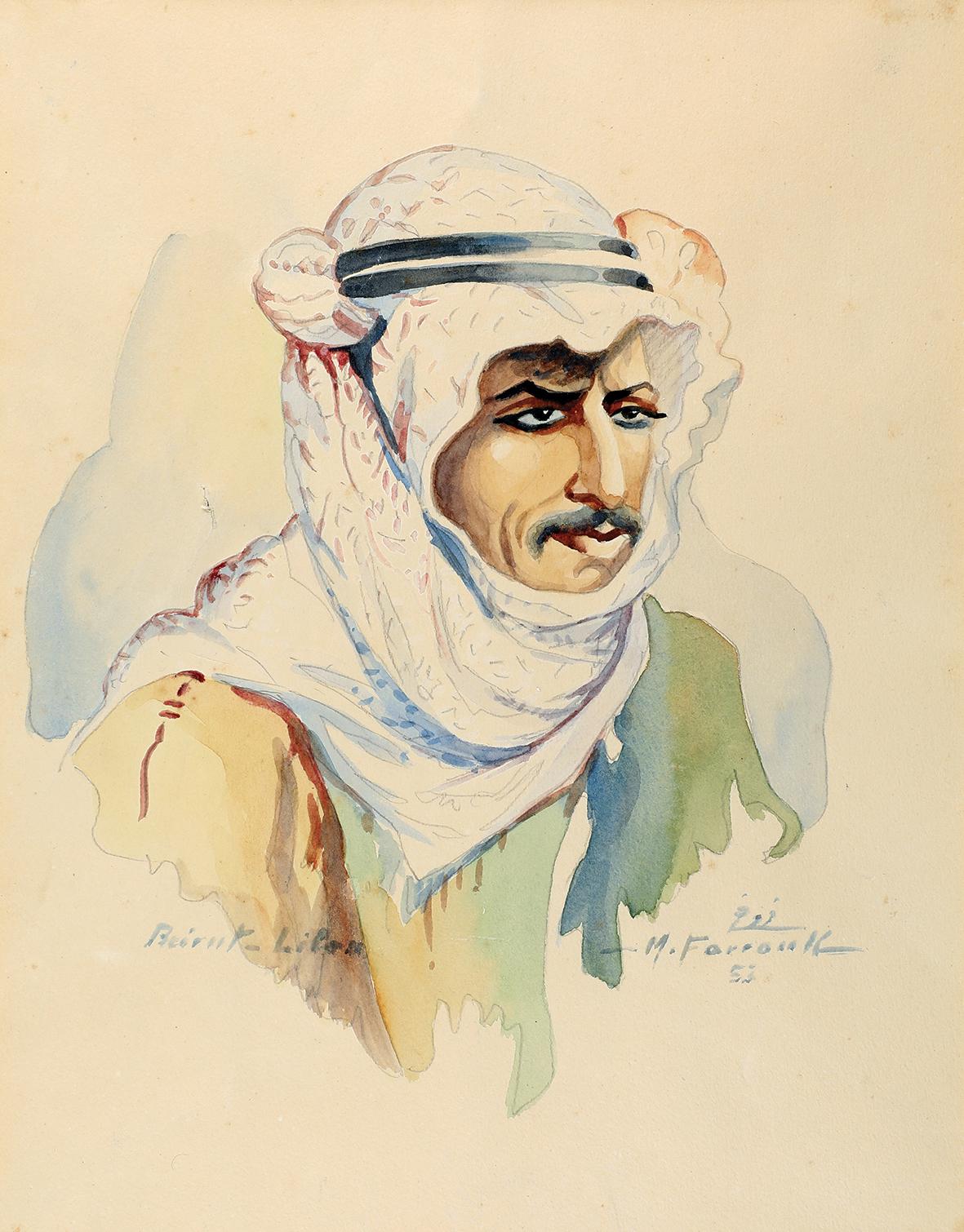
A century of drawings and works on paper traces how ideas travel across cultures and generations. From classical studies to Arabic calligraphy, each sheet reveals the lasting power of a careful hand and the importance of preserving our shared memory.
Nabu was the god who kept the record. In the ancient cities between the Tigris and the Euphrates, people believed that a single deity held the reed and the tablet. He wrote the order of the world, and guarded the account of every life. His emblem was a plain stylus. His great temple stood at Borsippa (South of Babel), and once a year his statue traveled upriver to Babylon to renew the record for the season to come. The people of this region built him temples because they understood something early. A civilization lives as long as its memory. And its memory lives on whatever surface a hand can mark. That surface, for most of the last two thousand years, has been paper. The word itself remembers where it came from. In Arabic, waraq means both the sheet and the leaf of a tree, so every page carries the memory of a living thing that once turned toward the sun. The old dictionaries give it two further lives, the bloom of youth and the shine of silver coin, so the word held beauty and wealth in its hands, and came to ink last. The greatest ideas of this region began small and began by hand. A thought became a line, a line became a letter, and a letter became a poem or a prayer or a plan for a city. Before any idea could travel, someone had to set it down. The setting down happened on the most fragile thing in the room. This is the paradox at the heart of everything gathered here. Paper feeds insects and drinks damp. Light fades it, time makes it brittle, and a single flood can end it in an afternoon. By every measure it should have vanished. Instead it outlasted stone and bronze, because a sheet invites a second hand to copy it forward, and a third, and a hundredth. The ideas endured because people chose to carry them. Every generation that copied a text or kept a drawing safe handed it to the next, and the chain held. That choice is why a museum exists. What hangs here comes almost entirely from one place. The works are drawn from the collection of the Nabu Museum and from the hand of its cofounder, with a single exception of drawings by Youssef Howayek and Daoud Corm, lent by the Fondation Charles Corm. We hold these works as their keepers, and we feel the weight of it. Each drawing in these rooms crossed a distance to reach us. Some traveled home rolled inside a leather portfolio on a ship or a plane from abroad. Some waited in a studio drawer for decades. Some came through a war, a move, and a change of country, along with the slow patience of a warm and humid climate that works against paper every hour of every day. That any of them reached this wall is partly a matter of luck, and luck alone makes a thin inheritance. Foresight makes it last. The artists who filled these sheets, and the families and collectors who kept them flat and dry and shaded, practiced a hushed kind of heroism. They protected the record decades before anyone told them it mattered. The task grows harder now. The air over this coast carries more heat and more moisture than it did a century ago, and the same conditions that press on a shoreline press on a sheet of paper hanging behind it. To gather these works is to accept a responsibility that reaches past the exhibition. We ask, gently, for greater care toward the written and the drawn across this whole region, because the memory held on paper is thinner and more precious than we tend to admit. What waits in these rooms is a century of that memory. You will meet a young painter learning the human body one plaster cast at a time. You will follow a hand that came home to draw a mountain and a narrow coast. You will watch the Arabic letter slip free of reading and become pure form. Many places call themselves a crossroads. This one has the paper to prove it. In these rooms a classical study of the figure hangs near a sweep of Arabic calligraphy, and neither looks like a guest. What the eye might rush to sort into East and West turns out to share one reed and one sheet, joined by an older habit than any border, the habit of beginning an idea by hand. Some of these sheets were finished works, signed with pride and built to last. Others were studies caught in a single day, the first breath of an idea before the color and the fame arrived. Both kinds belong here, because on paper the journey and the destination often wear the same face. A quick sketch can hold a whole life inside a few lines. A rehearsal can outshine the performance it prepared. Sometimes the road turns out to be the arrival. Nabu kept the record so that a people could remember itself. We gather these pages in the same spirit, and we invite you to look closely at each one. Every sheet here is proof of a simple and stubborn thing. An idea, once set down by a careful hand, can travel further than the person who made it, and can outlive the century that gave it shape.
Collections
Waraq وَرَق
44 items